Center of Women’s Studies and Policies Sofia 1000, 38 Tsar Asen street, phone: ++359 2 981 04 73, E-mail: cwsp@cwsp.bg (+359 2) 980 6265, e-mail:cwsp@cwsp.bg
Project Gaining a Common Perspective for an European gendered democratic Policy - GCPEP
(CWSP)
About the project
The project GCPEP № 2009-1-DE2-GRU06-001820 6 was funded by the EU Life Long Learning Program, subprogram Grundtvig Learning Partnersips 2009-2011 and was implemented in the period September 2009 - July 2011.
Aims and objectives: Development of new interdisciplinary educational methods trough dialogical communication to explore in scientific manner diverse historiacl experiences of women in Eastern and Western Europe. Exchange between partners on rethinking of women history and hidden qualifications of women as agents of cultural and political values - common to all citizens of Europe.
Activities:
5 Transnational Project Meetings in countries with historically different political developments to discuss: the experience of women in Eastern and Western Europe in the period 1938-1958; the two levels of the history - the teached history and the history, retold by women; the new non dualistic approaches of political values rethinking - personal and national pride and identity; formulating of new common values - human rights in the context of women history.
Activities to popularize partner's organizations and the process of gaining common perspective of European gendered democratic policy.
In Bulgaria a non formal group of researchers and post graduates called feminar gathered within the lifetime of the project and discussed the possibilities innovative approaches as biographical method and oral history as well as documentary films to be used as methods to teach and explore women history.
Center of Women's Studies and Policies organized in cooperation with the Sofia University "Saint Kliment Ohridski" an academic conference"Gender and Transition 1938-1958". More information about the conference.
Results and impact:
On personal level - participants developped selfawareness and selfconfidence trough communication and dialogue for better understanding of women history in Eastern and Western Europe. On organizational and European level - strenghtenning the network of professionals working in favour of the common European values - democracy, cooperation, equal opportunities and gender equality trough exchange of good practices, information and knowledge. Educational methods developped within the project could be succesfully used and developped further in future life long learning initiatives and projects of the partners.
As a result of the study on the influence of gender equality policies in diffrent socio political contexts in the past, partners gained a common perspective for European gendered democratic policy.
The project is funded by the European Lifelong Learning "Grundtvig" Programme trough the National Center for Development of Human Ressources, aiming at the promotion of adult education. This publication reflects the views of the author only, and the European Commission or its services cannot be held responsible for any use which may be made of the information contained therein.
Partners
Cooperation between partners - museums, research organizations and institutes and non governmental organizations was based on a very high level of personal appreciation and respect for the opportunity to exchange ideas for representation and learning of women history and gendered democratic policy in Europe. All partners hosted one transnational meeting and had the possibility to present their organizations, history of the country and cultural heritage.
Transnational meetings of the project team were organized as work sessions of participants for getting an impression of the host country and especially a more detailed picture of the partner's organizations and their fields of activities and for visiting places and institutions, related to the topics. Special input of partners were their contributions in each of the transnational meetings referring to the subject of gender equity and exchange, dialogue and discussion between partners on the inputs and impressions of sharing knowledge, experience and feelings and opportunities to express the sudden insights faced with diversity of partner countries and biographies of women from Eastern and Western Europe from the period 1938-1958, presented in the project.
Main aim of the meetings was to formulate common European values, to share the diverse experiences of women in Europe, to communicate and exchange thoughts and feelings on common values and possibilities for transforming this experience in scientific approach for learning democratic society trough historical and political gendered perspective.
First Transnational Meeting took place in Bonn, Germany from 11.12 to 14.12.2009. Partners discussed the common subject, project management aspects and plan for project inplementation. Topic of the meeting was: " Common Roots of European History. Women's Perspective on the Roots of Euroepan History".
Second Transnational Meeting took place in Athens, Greece from 23.04. to 26.04.2010. Topic of the meeting: "Remembering Stories in the Spiral of Time". Participants discussed the gender perspective in retolding and rethinking of history, past history and present visions of a gendered democracy in Eastern and Western Europe.
Third Transnational Meeting took place in Aarhus, Denmark from 17.09. to 19.09.2010. Topic for discussions was: "Violance against Women in War Time". The excahnge was enriched with a presentation of a collection of the Women's Museum in Aaarhus and perception of women's history in the museum with special attention to violance.
Fourth Transnational Meeting, held in Sofia, Bulgaria from 8.04. to 10.04.2011 was dedicated to "Political Participation of Women in the period 1938-1958".
Fifth Transnational Meeting took place in Tallinn, Estonia from 17.06 to 20.06.2011. Topic for presentations was:" Women and women organization in Education and Culture".
Visit of CWSP team in Women's Museum in Aarhus:
Academic conference Gender and Transition 1938-1958
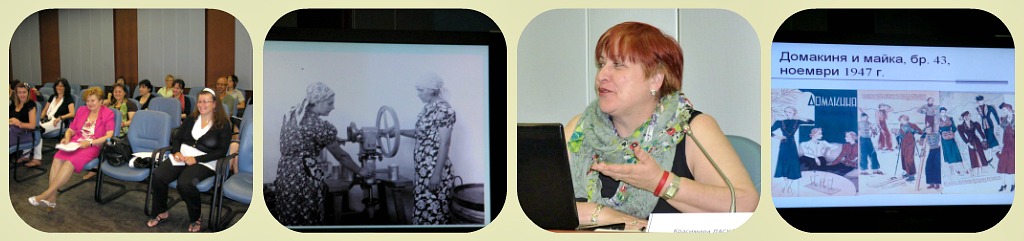
On the 21 and 22 of June 2011 Center of Women's Studies and Policies in cooperation with the Sofia University Saint Kliment Ohridski organized an academic conference:"Gender and Transition 1938 - 1958". The purpouse of the conference was to provide floor for discussions on the diverse aspects of women history in the transition period before and after the II WW: gaining of political and civil rights; participation of women on labour market; policies and gender public discourses; representations, vizualizations of women in art and media.
The conference was organized within the framework of the project " Ganing Common Persepcitve for European Gendered Policy" - GCPEP - 2009-1-DE2-GRU06-0018206, by CWSP as a partner funded by EU Life Long Learning Programm, Gruntdvig Learning Partnersips 2009 -2011 trough the National Center for Development of Human Ressources.
Compendium
Center of Women's Studies and Policies collected the articles and presentations of the Academic Conferene Gender and Transition 1938-1958, held within the project lifetime. The compendium will be published in Bulgarian language.
For more information about the topics presented and discussed on gender, transition, women's movement and organizations, legislation and charity, women prisonners in camps and representations of women in Bulgaria within the remarkable period of 1938-1958 we provide some information about the content of the compendium in English:
CONTENT:
PART 1 Women in Public, Economic and Cultural Life (1938 - 1958 )
Changes in the Economic and Social Status of Women in Bulgaria (1938 - 1958 ), Rossitsa Rangelova
Transition and Family Legislation in Bulgaria (30-50-s of the ХХ century), Svetla Baloutzova
Women in Award System in Bulgaria (30 - 50-s of the ХХ century), Georgeta Nazarska
Municipal Services and Involvement of Women Initiative in Charity and Social Work, Kristina Popova
Women Agronomist and Teachers on Housekeeping in Farms in the Program "Model Village" (1937 - 1944 ), Мilena Angelova
Traditions and Innovations in Rhodopian Womens' Life in the Period of Transition (1938 - 1958 ), Nadya Velcheva
Women Camps' Prisoners. The Collective Memory of One Generation, Ana Luleva
The Staffing File of One Woman Archivist in the Central Studio for Chronicle and Documentary Films (June 1949 - May 1951), Marijana Piskova
Women in Labour Cooperative Agricultural Farms or How the Policy for Gender Equality was Implemented in the Bulgarian Village, Yana Yancheva
Expansion of the "Private Space" in the Public Sphere (Magazine "Woman today" 1954-1958), Joana Pavlova
PART 2 Organization of women and women in organizations
Tutored Representation of Women in Bulgaria (1944 - 1958), Iliana Marcheva
Women Associations in the Second Half of the 40s: One Male Initiative for Women's Equality, Nurie Muratova
Marginalization of Women in the "Associations of the Fighters against Fascism" in the 40s - 50s years of the ХХ century - the Old Patriarchalism in a New Antifascist Rhetoric, Petar Vodenicharov
Women's Movement of the Town of Rousse in Transition, Reneta Roshkeva
The Women in Red: The Committee of the Movement of Bulgarian Women and the Development of Progressive Women's Movements in Africa and Asia, 1980-1985., Kristen Ghodsee
PART 3 Interpretations
Expansion of the Women Labour: Reproduction and Professional Realization, Katia Vladimirova
The Overcoming of the Gender during the First Decade after the 9th of September 1944 - the Utopic Culmination of the Marxist Feminism, Gergana Popova
Soc Feminities and Soc Masculinities: Heroes and Simulations, Ralitsa Muharska
The State Feminism of the State Socialism: contradictio in terminis?!, Krassimira Daskalova
The main objectives of the project are to change the attitude to the preservation, description and digitalization of women and minority documentation and to contribute for the democratization of the access to them as a part of cultural heritage and to make easier the access to the cultural and historical heritage of women and ethno-religious groups by encouraging the elaboration of electronic data base of the archive and oral history documents and methodologies of their implementation.