Center of Women’s Studies and Policies
Sofia 1000, 38 Tsar Asen street,
phone: ++359 2 981 04 73, E-mail: cwsp@cwsp.bg (+359 2) 980 6265, e-mail:cwsp@cwsp.bg

Facts and Figures
Higher Education

Below you can find some data about the female and male university students in EU 27 by subject areas, taken from Eurostat, the Statistical Office of the EU:

In 2005  81% of the students in the EU 27 who study Social Services are female. Other fields where female students dominate are Education Science (77%), Teacher Training (75%), Health and Welfare (75%). Humanities (68%), and Arts (66%), Journalism and Information (64%) are also preferred fields by women.

On the other hand, 36.9% of tertiary students in science, mathematics and computing disciplines in the EU-27 were female in 2005, while in engineering, manufacturing and construction there were only 24.3 % of female students. Other underrepresented fields of studying are Computing (20%), Transport Services (20%) and Engineering, Manufacturing and Construction (24%). (Source: Eurostat)

"Disparities in educational attainment levels between the sexes have been reduced and even reversed throughout the EU over the last 30 years, such that women have generally overtaken men in terms of the average qualifications they obtain. As a result, EU educational policies have increasingly shifted to promote particular subject areas, where take-up among female students remains relatively low (for example, science, mathematics and computing, or engineering, manufacturing, and construction-related studies)." (Source : Europe in figures - Eurostat yearbook 2006-07, p. 92-93)

Where is Bulgaria?

In 2005 in Bulgaria there were slightly more women than men university graduates - 52.1 %. For comparison - in 1998 this figure was 60.9%.

In science, mathematics and computing disciplines their percentage is 48.9% in 2005 (compare to 58.4% in 1998), while for those studying engineering, manufacturing and construction related studies was 32 % (39.6% in 1998). (Source: Eurostat)


Women in Power


In the last 100 years, only 24 women have been heads or state governments! In 2007 in the world, women hold only 17.5 % of seats in the Parliaments. There are some countries, however, where more women hold important positions: in Rwanda, 48.8% of the Lower House of the Parliament is composed of women. In Finland the Government consists of 12 women and 8 men. Currently, women are Presidents of: Chile - Michelle Bachelet, of India - Pratibha Patil, of Liberia - Ellen Johnson-Sirleaf, of the Swiss Federation - Micheline Calmy-Rey

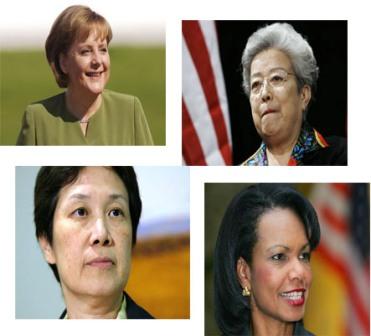
Germany' Chancellor Angela Merkel, China's Vice Premier and Minister of Health Wu Yi , Chief executive of Singapore Temasek Holdings Ho Ching and US Secretary of State Condoleezza Rice are ranked as the most powerful women in the world according to the 2007 listing of the Forbes Magazine.  

Sources: Inter-Parliamentary Union/Women in Parliaments; Women World Leaders; Forbes.com/ The 100 World's Most Powerful Women


  Angela Merkel, Wu Yi, Ho Ching,  Condoleezza Rice

Photos source: Forbes.com

Where is Bulgaria?

The women MPs in Bulgaria are 53 out of 240, which makes 22.08%. All highest positions of the Republic of Bulgaria are occupied by men - President and Vice President, Prime Minister and Chairman of the National Assembly.

We have never had a woman President. From 1992 to 1993 Blaga Dimitrova, poetess and writer, was elected Vice President with the President Zhelyu Zhelev (1990-1997).

Of the 17 Ministers we have 4 women, one of them a Deputy Prime Minister and Minister of Disaster Management Policy. The other 3 head the Ministries of Justice, Labour and Social Policy and European Integration. In only 22 out of 264 municipalities in Bulgaria we have women mayors. Data as of July 2007.

After the local elections in 2007 in 23 municipalities were elected women mayors. 

 Sources: http://www.government.bg/; http://www.parliament.bg/; http://www.president.bg/; http://www.cwsp.bg/


Some historical facts about our grandmas

  • The first school for young girls in Bulgaria was opened in 1840 in Pleven by Anastassia Dimitrova.
  • The duration of study at high school for girls and for boys was made equal in 1898.
  • Between 1899 and 1904 women teachers were not allowed to practice the profession after their marriage.
  • The first female students were admitted at the university in 1901.
  • In 1937 only married and divorced women or widows obtained the right to vote.
  • Until the end of the 20-s of 20 century the law determined that the remunerations of women teachers should be 10% lower than those of men teachers.
  • Women lawyers did not have the right to practice as magistrates or solicitors before 1944. 
  • In Bulgaria women obtained full voting rights - the right to vote and to be elected in 1947.


Copyrights © 2003
Center of Women’s Studies and Policies